Head of Service and Interaction Design, UK Government – Department for International Trade
Design strategy and leadership: Building a joined-up export platform helping UK businesses start exporting
Turning disconnected tools into one digital backbone for Britain’s exporters
A fragmented ecosystem of 20+ services, tools, and legacy CRMs brought together into one national export platform anchored by Data Hub and a shared information model.
Context and Challenge
Just before after Brexit, export support was scattered across disconnected tools, policy areas, and delivery teams.
Small businesses struggled to understand new rules. Trade advisers lacked a single view of the businesses they supported. Performance reporting was unreliable.
Export performance is directly tied to national economic growth. Every missed opportunity, repeated question or lost piece of context meant a slower economy and poorer outcomes for UK businesses.
Between 2017 and 2020, I led the design strategy for a multi-product platform that reconnected this ecosystem, turning fragmented services into one coherent backbone for the UK’s businesses.
Key challenges included
Fragmented journeys with repeated data entry
No shared platform spine or interaction model
Legacy CRMs not designed for trade relationships
Limited metrics and unreliable export-win reporting
Financial Times, 2017
“One in three SMEs put export plans on hold amid Brexit confusion.”
UK SME owner
“If I get the product code wrong, I could lose money at the border.”
International Trade Adviser
“I want to see the whole journey of a business, not just a single transaction.”
Our first step to build a better, unified platform was understanding and mapping the exporter journey end to end. This revealed where guidance broke down, where users repeated themselves, and where services operated in isolation.
Insight
Fixing the user journey meant fixing the data behind it. Every service, from Export Academy to the adviser CRM, needed to share a common model and vocabulary.
The shift came when we reframed design’s role from improving individual interfaces to shaping how data, people, and services connect across the ecosystem.
This became the foundation for a single, coherent platform.
To move beyond static personas, we analysed behavioural patterns across the service blueprint and mapped how different user types navigated the ecosystem. This helped us create the Unified Export Experience Framework that matched real exporter behaviours. It mapped:
the key user activities (opportunities, compliance, support, country information, events, engagement)
the government mechanisms behind them (policy, commercial intelligence, trade support, organisational constraints)
Export journeys weren’t linear or circular. By analysing patterns across thousands of businesses, we developed the Unified Export Experience Framework, mapping real behaviours across opportunities, compliance, support, and guidance. It showed when exporters needed continuity, when they needed expertise, and where shared data became essential.
Personas helped us understand motivations, expectations, and readiness, but we soon learned they weren’t enough on their own. Exporters behaved differently depending on product complexity, market maturity and experience
The Unified Export Experience Framework helped us trace real user routes through the export journey. It showed that exporters jump between compliance, opportunities, and guidance depending on context, revealing where shared data and joined-up design were essential, and helping to predict how their needs might evolve over time.
Approach
Defined a shared vision
We defined one vision: a platform where a business could learn, plan, find opportunities, and receive advice without starting over and where advisers saw the full journey in Data Hub.
Led design for Data Hub and over 20 services
We provided product and service design leadership for DIT’s bespoke CRM used by more than 3,000 trade advisers worldwide, integrating it with public-facing tools and aligning it to shared design principles.
Unified experience and data architecture
Working alongside data architects we connected public services with Data Hub to create a reliable, shared source of truth for advisers and policymakers.
Established cross-discipline design alignment
To ensure cross-team design alignment we embedded the principles:
Ask once, use everywhere
Continuity over silos
Evidence over assumption
A business starts learning, builds its plan, finds opportunities, and advisers see every step in Data Hub without the user ever repeating themselves.
‘Ask once, use everywhere’ became the core design principle across public tools and Data Hub.
Built enabling foundations
Delivered Single Sign-On, business verification, a consistent information architecture model, and the Magna Design System to ensure cohesive delivery across the services.
Introduced service-mapping and UX-strategy frameworks Helped policy, data, and engineering teams see how every service connected to the next.
Maintained a unified roadmap
Worked with Heads of Product, Delivery, Research, Content Design, Data, and Engineering to balance policy ambition, user needs, and delivery capacity.
To make joined-up delivery possible, we introduced a shared operating model that worked across multiple product teams. This example shows how we aligned the Export Plan, SSO, and Data Hub teams around quarterly missions, dual-track agile methodology, and continuous discovery. It created one rhythm, one set of goals, and one shared understanding of user needs.
From a trade event to an export win: How one business was supported end to end
Let’s follow Sarah Patel, founder of the BrightRide, creator of smart bicycle lights, as she goes through a first-time export journey.
While Sarah isn’t a real person, every step in her story reflects the real workflows, systems, and interactions we designed across the UK’s export support platform: from learning and planning to CRM, opportunity matching, and ministerial reporting.
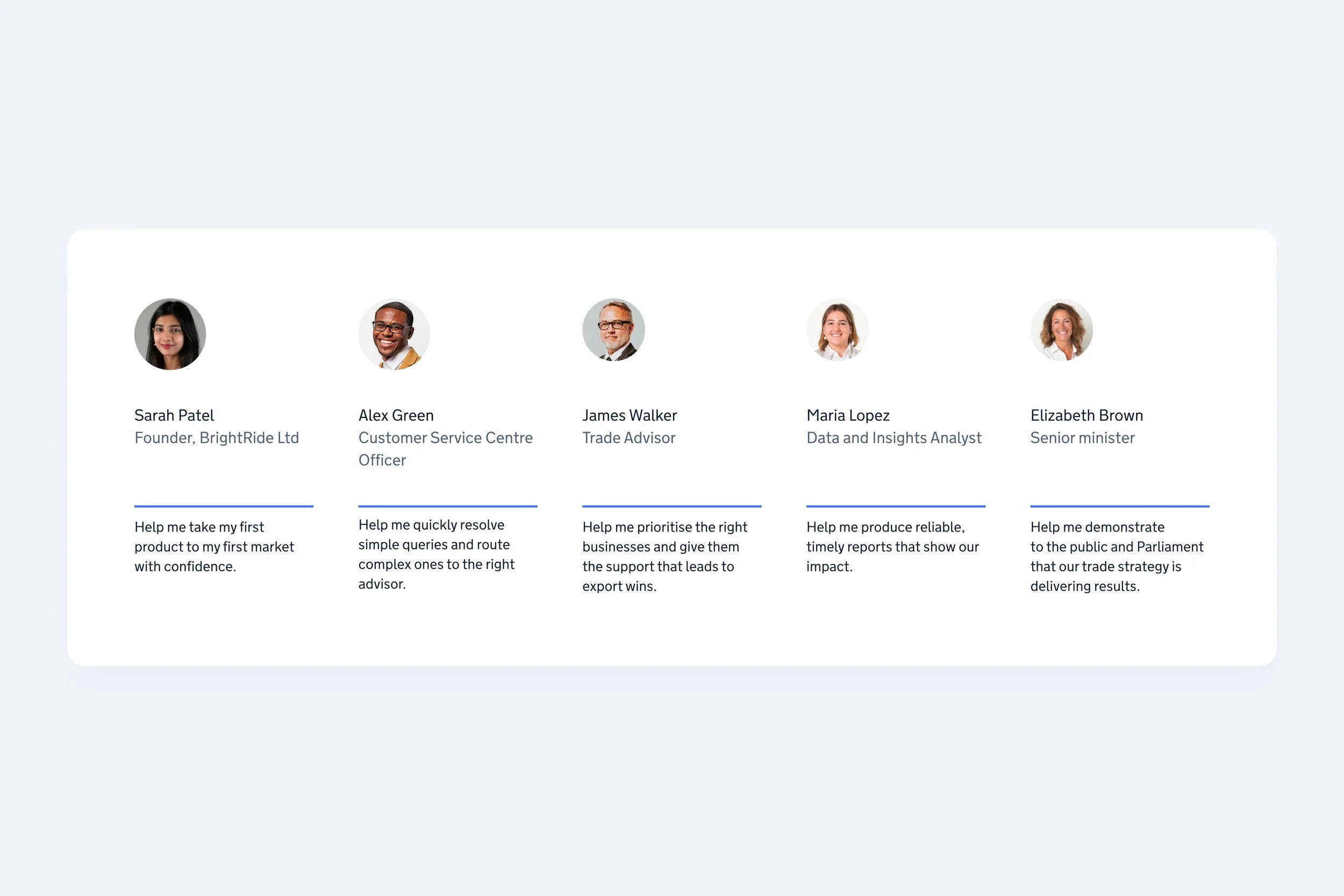
Behind every export win are many people. These four personas represent a small part of over twenty roles we supported through the joined-up export platform.
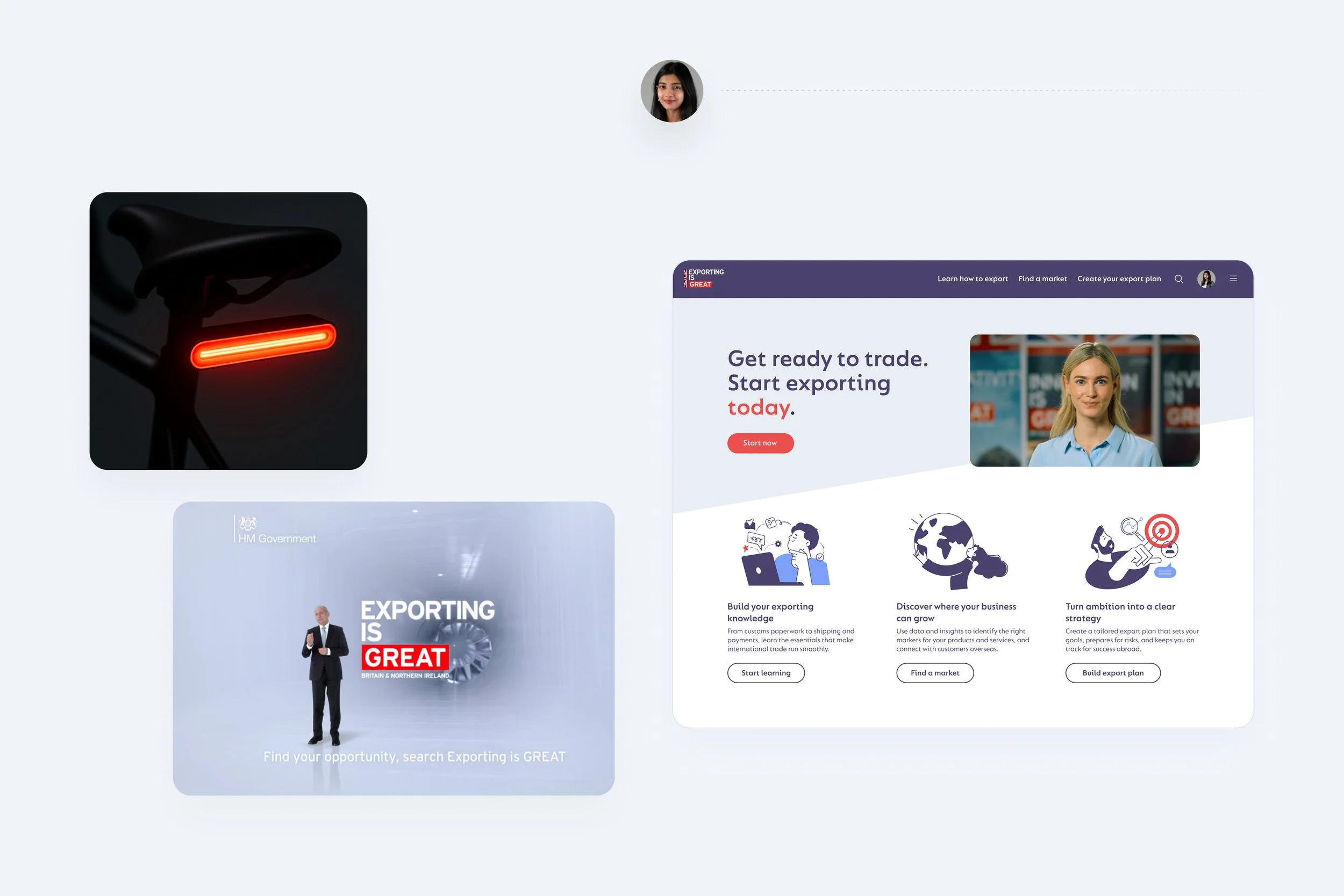
Sarah attends a government trade event and hears about great.gov.uk. She goes online and starts learning about exporting for smart devices.
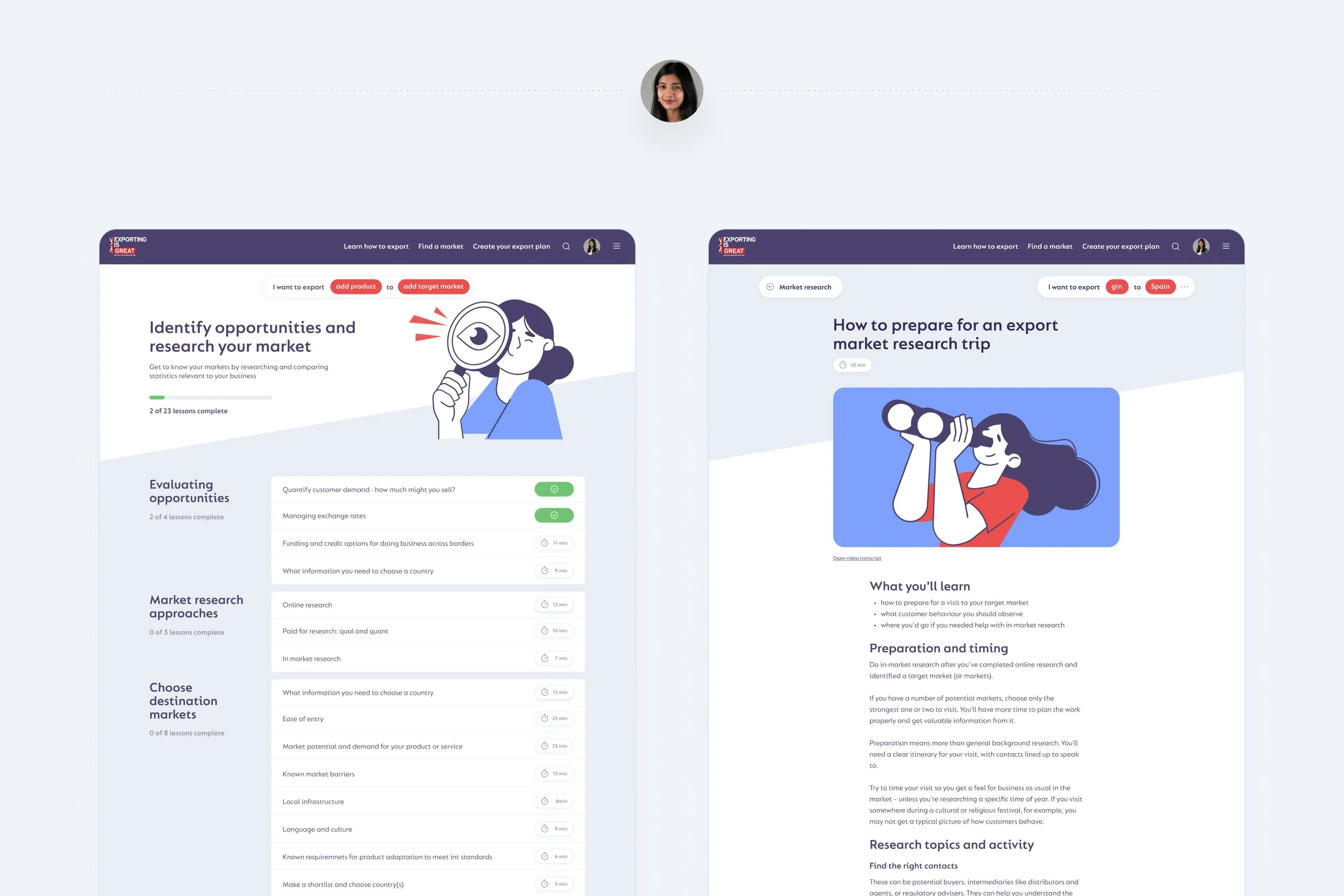
She takes a few lessons on identifying opportunities. The learning experience supports multiple formats and is designed for different types of learners.
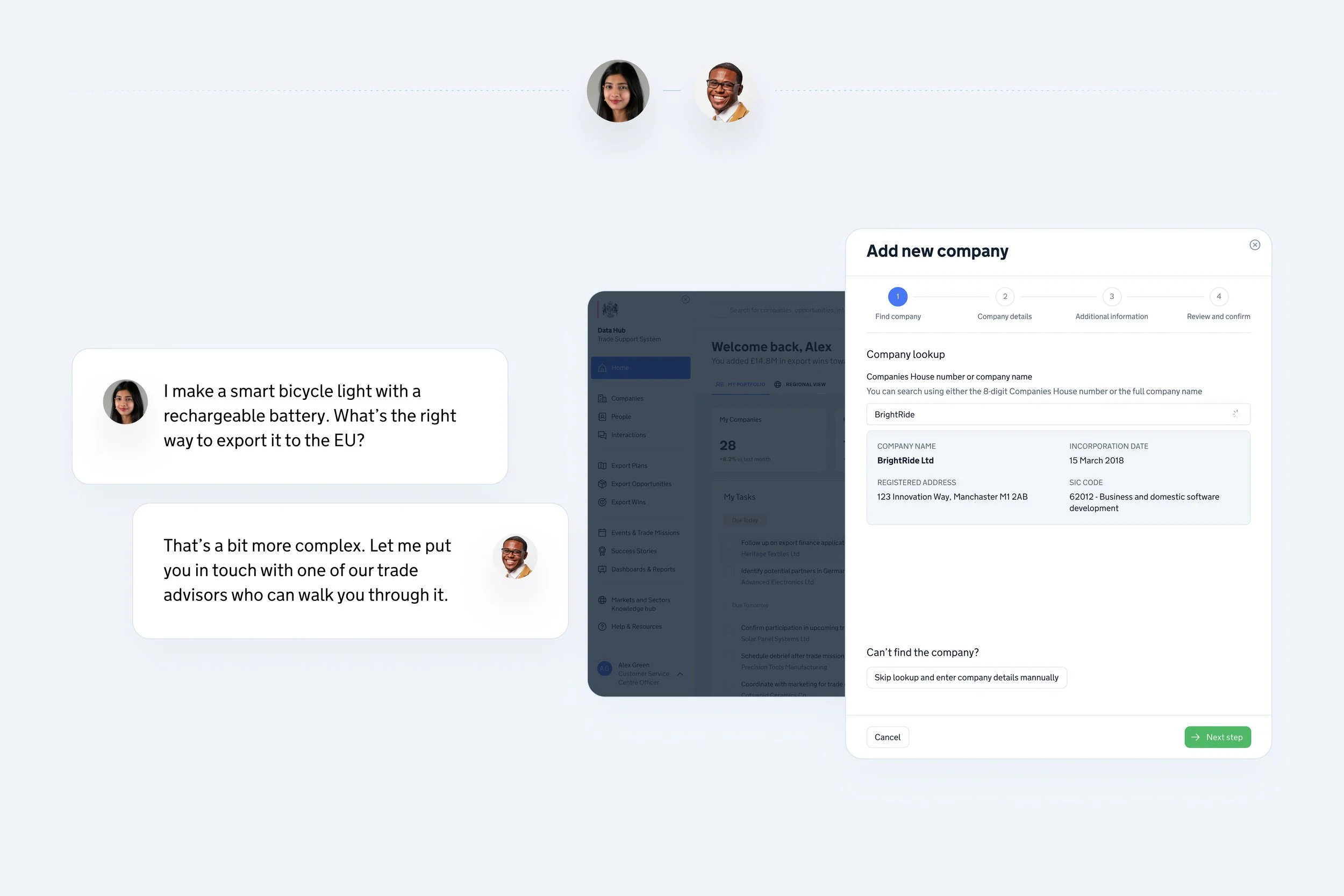
As many business owners do, she messages the department. Alex, a customer service officer, realises this is not a routine FAQ. He creates a company record using Companies House lookup and logs all details.
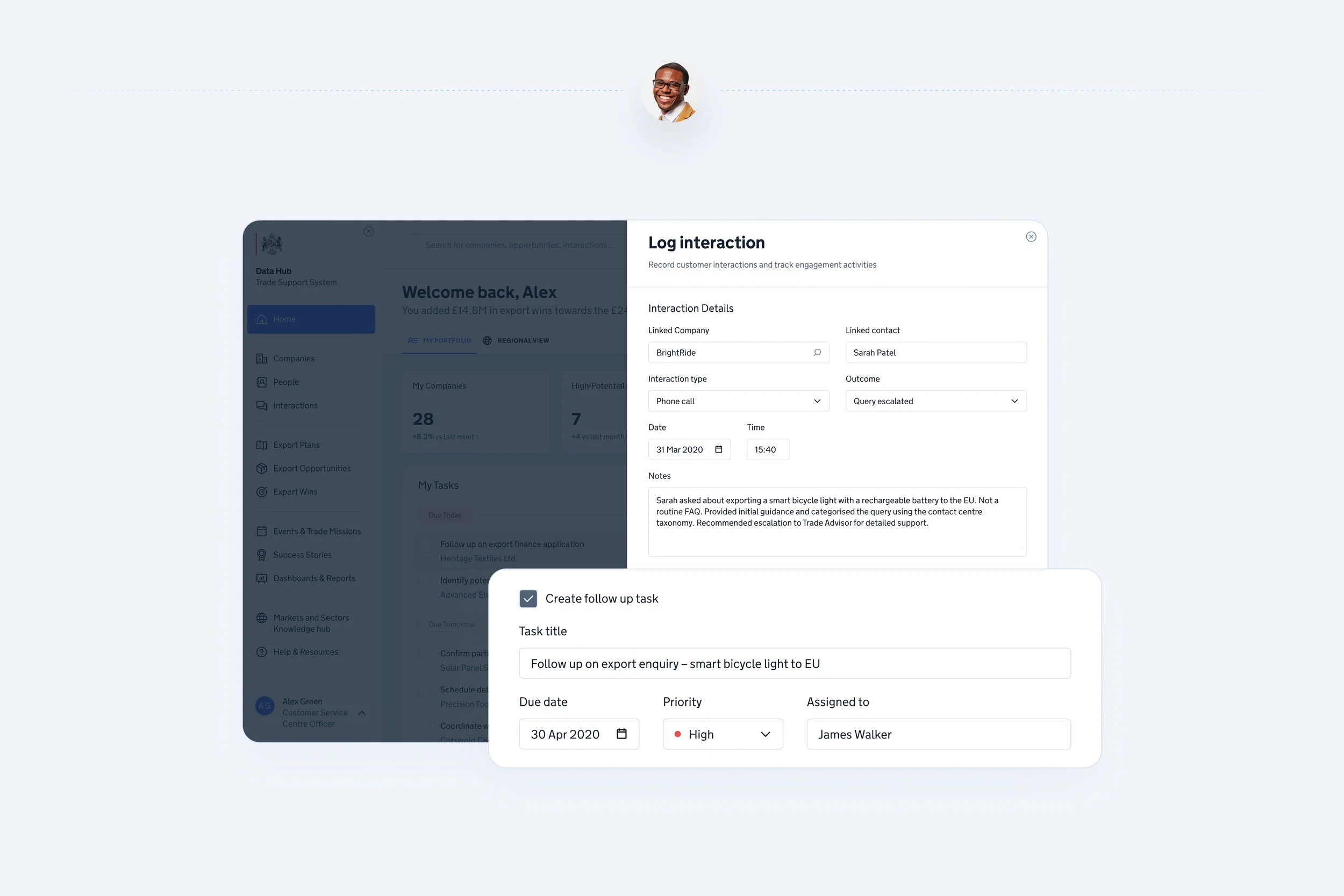
Using the contact centre taxonomy, he categorises the query and routes it to the right advisor. Previously, this would have been handled through spreadsheets and email.
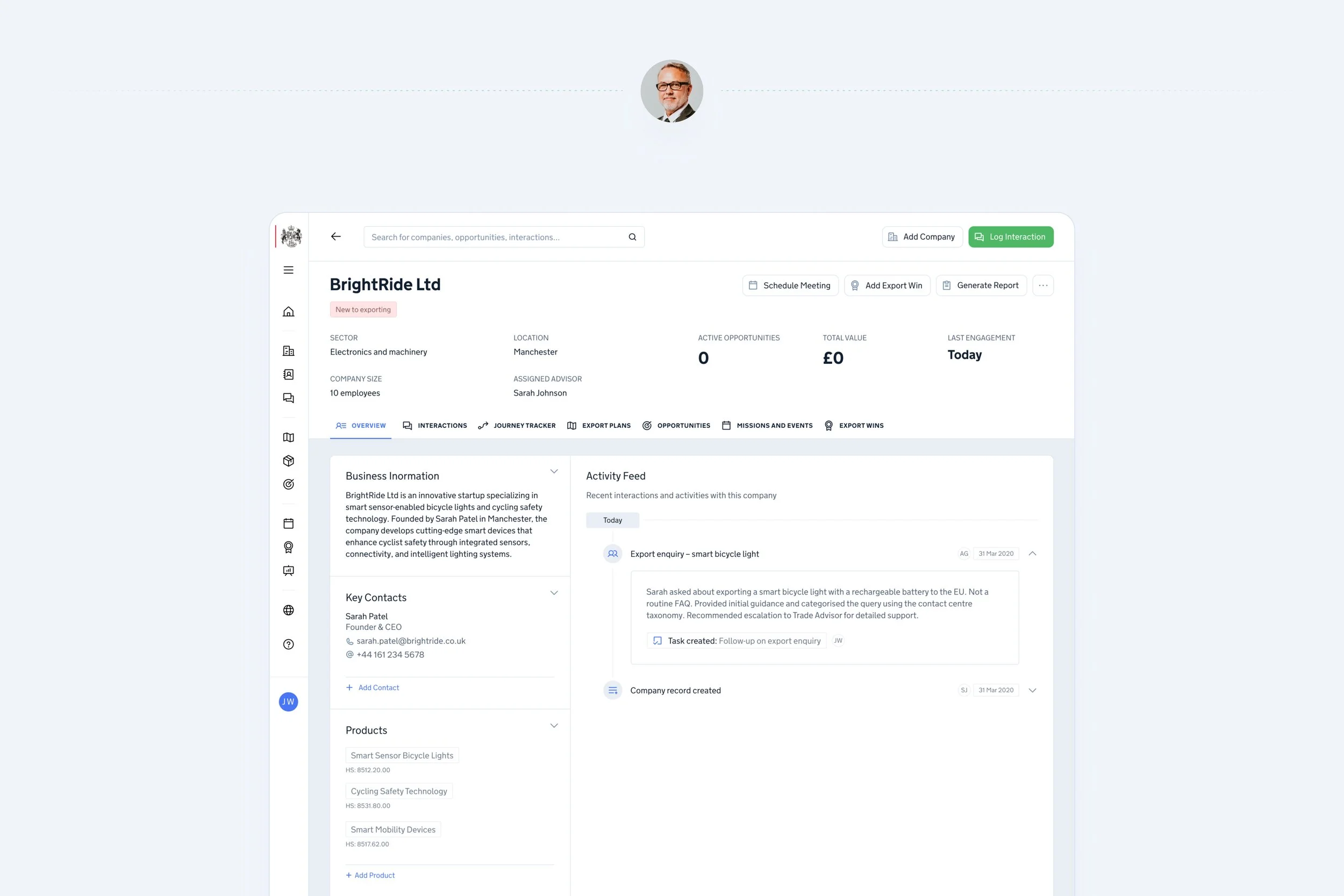
James sees BrightRide is in a priority sector and calls Sarah.
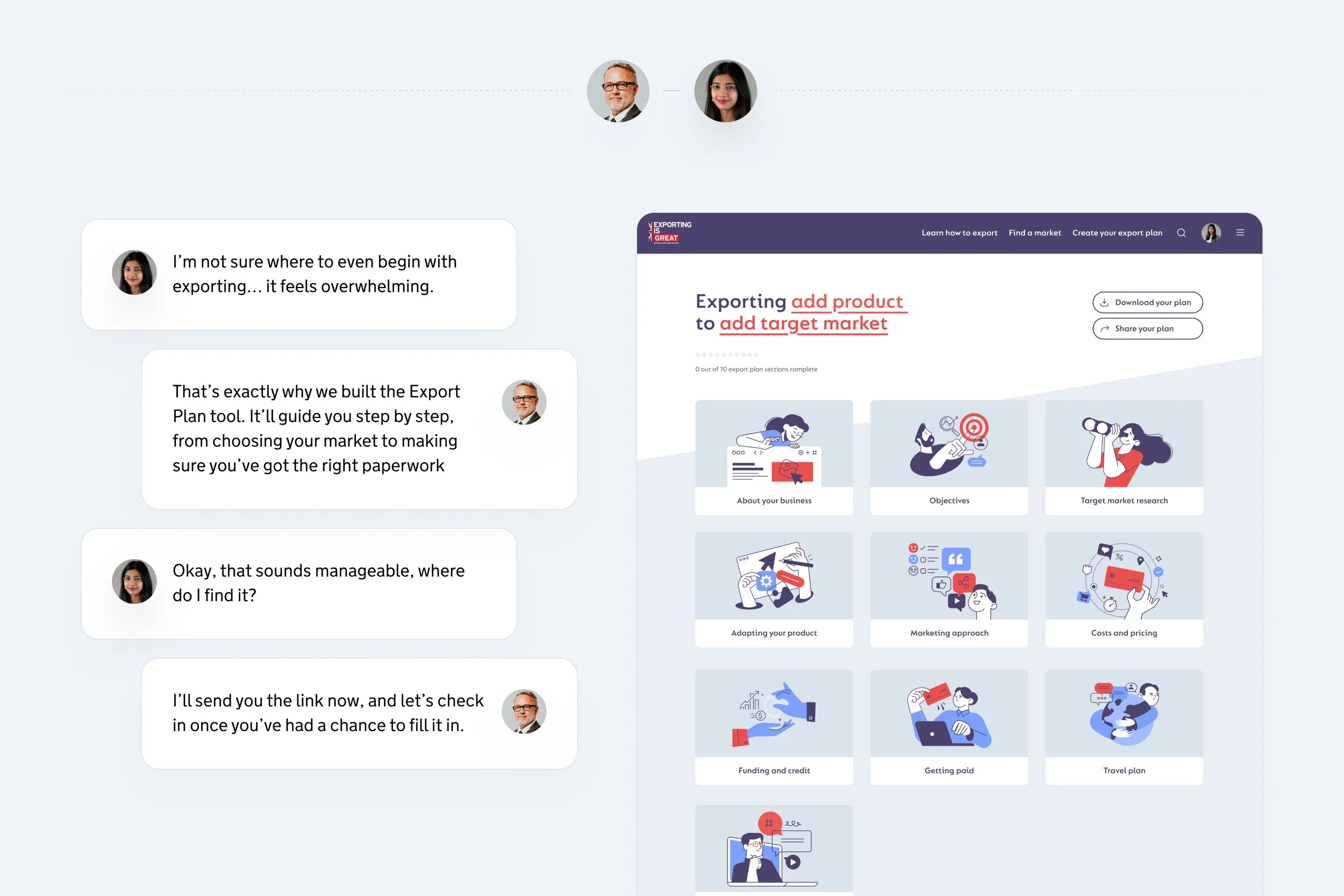
He guides her through the next steps and encourages her to complete the Export Plan.
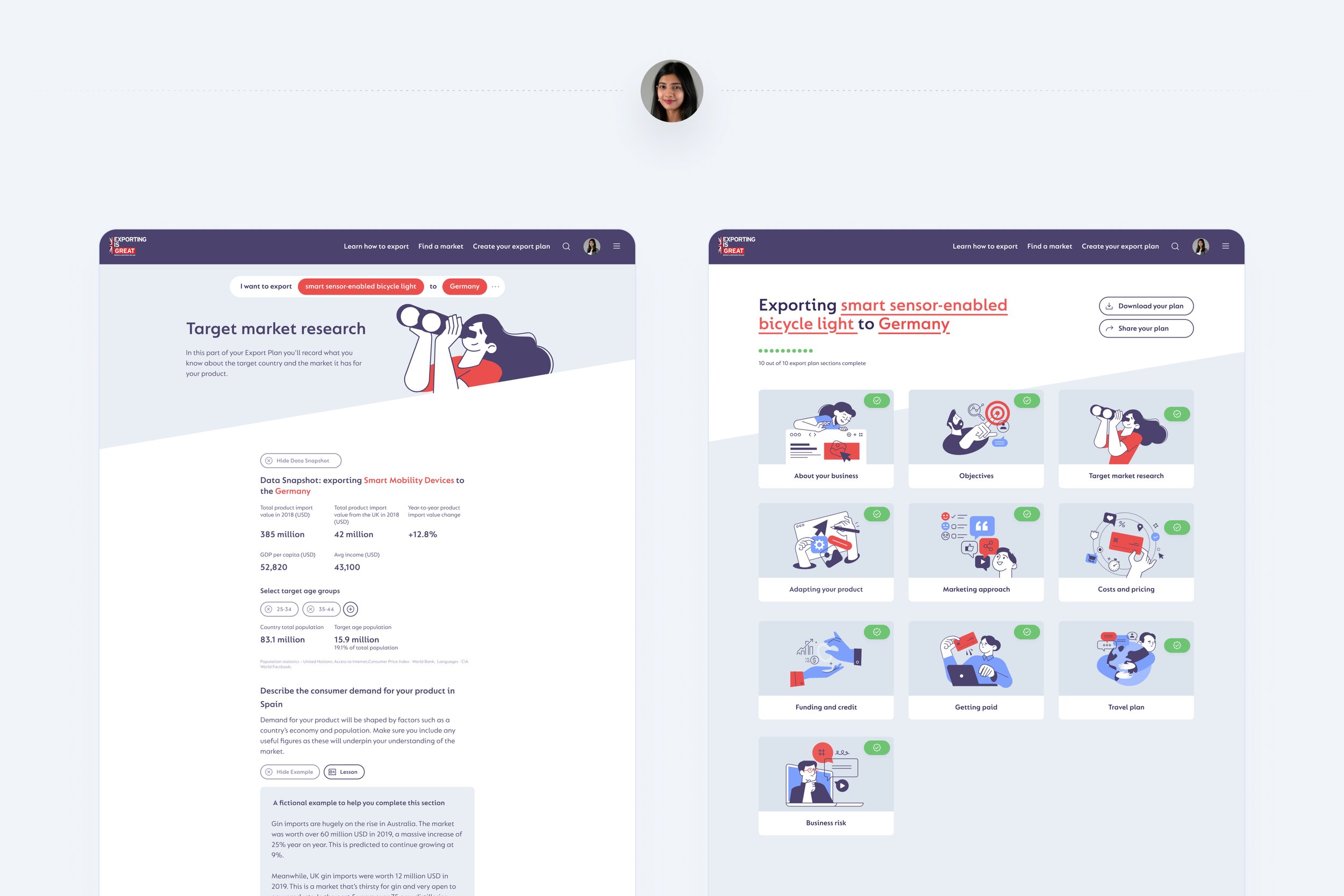
As Sarah completes her plan, she clarifies her product, target markets, barriers and opportunities. Her completed plan becomes a foundation for targeted support and opportunity matching.
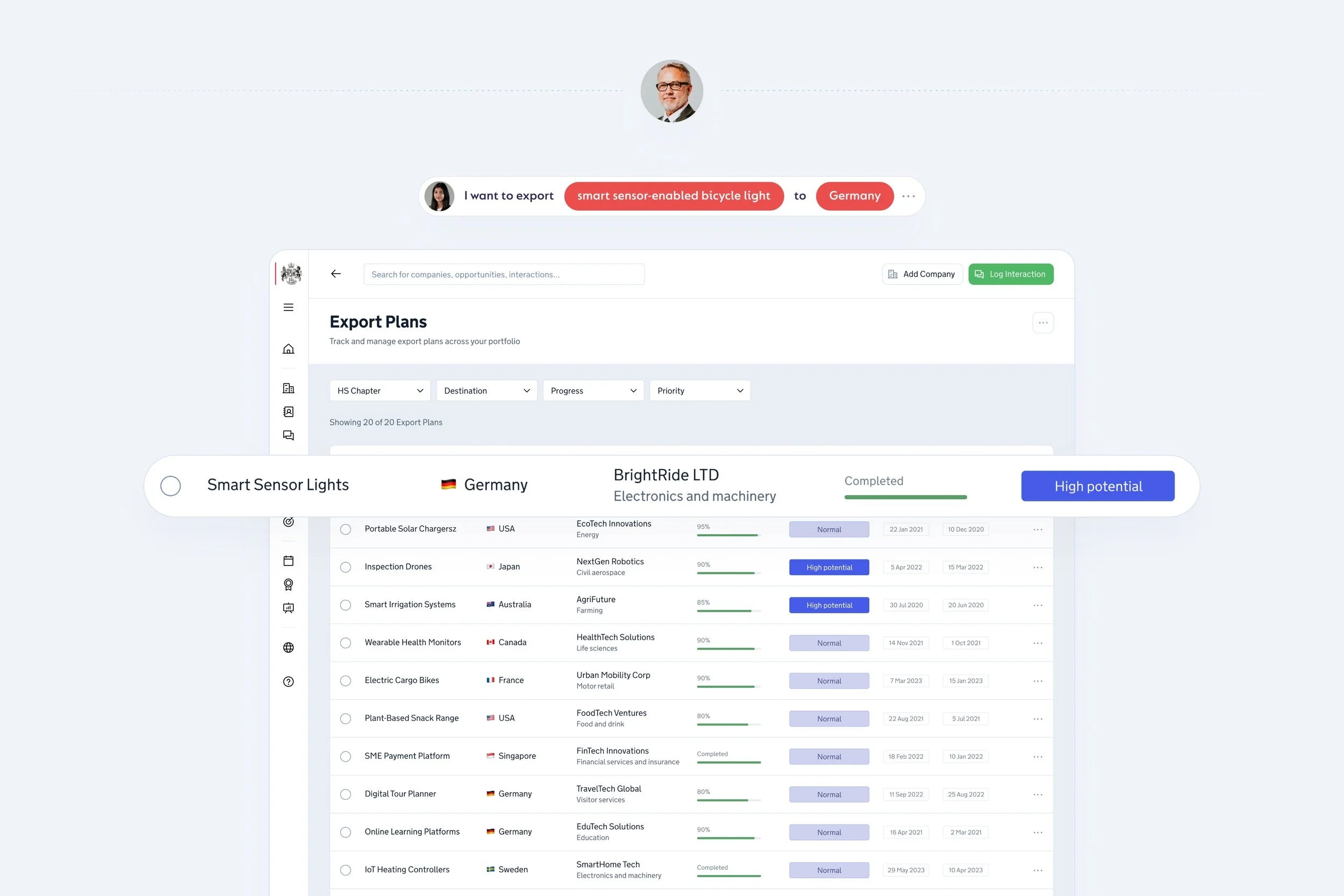
The system now understands her products, target markets, and readiness. This automatically enriches her company profile in Data Hub. High-potential businesses are flagged for advisers to prioritise.
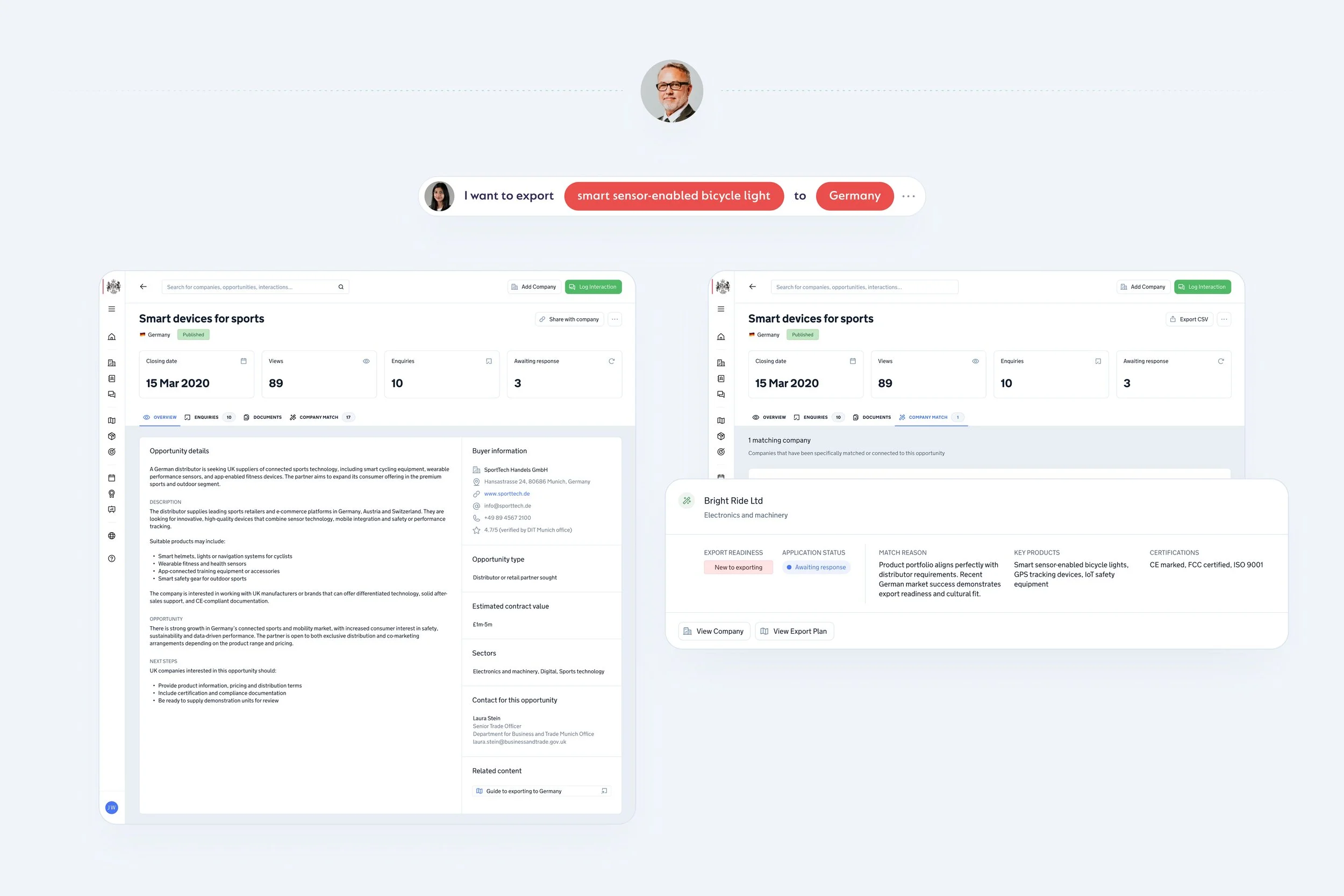
James finds relevant opportunities and pushes them to Sarah. Some matches are automatic through our backend intelligence.
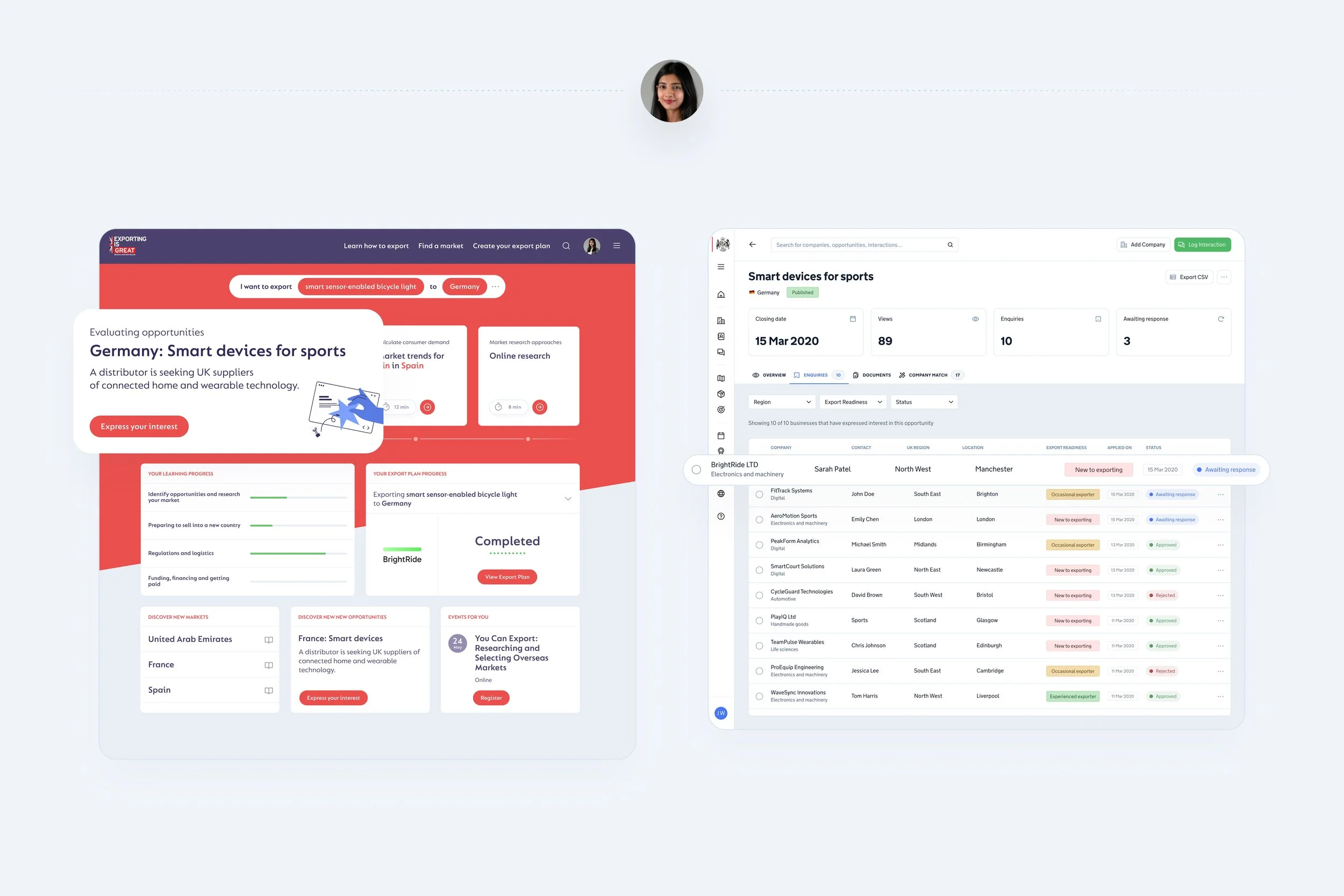
Opportunities surface directly on Sarah’s dashboard and she expresses her interest. Her application is logged in Data Hub. James reviews and forwards it to the overseas buyer.
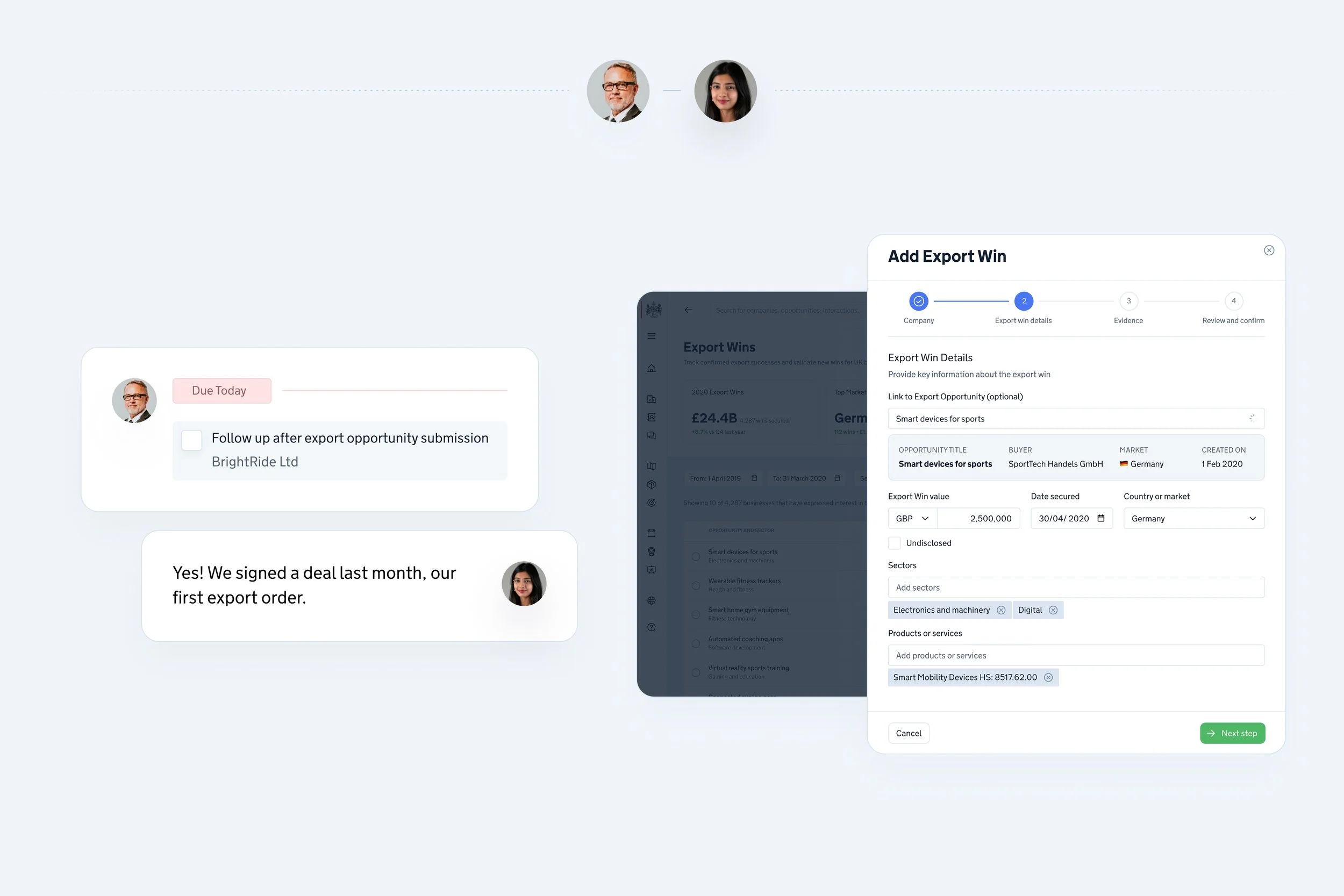
Wins are not tracked automatically, so advisers contact businesses to confirm outcomes. Reminders ensure nothing is missed. James logs the confirmed export win and links it to BrightRide and the original opportunity.
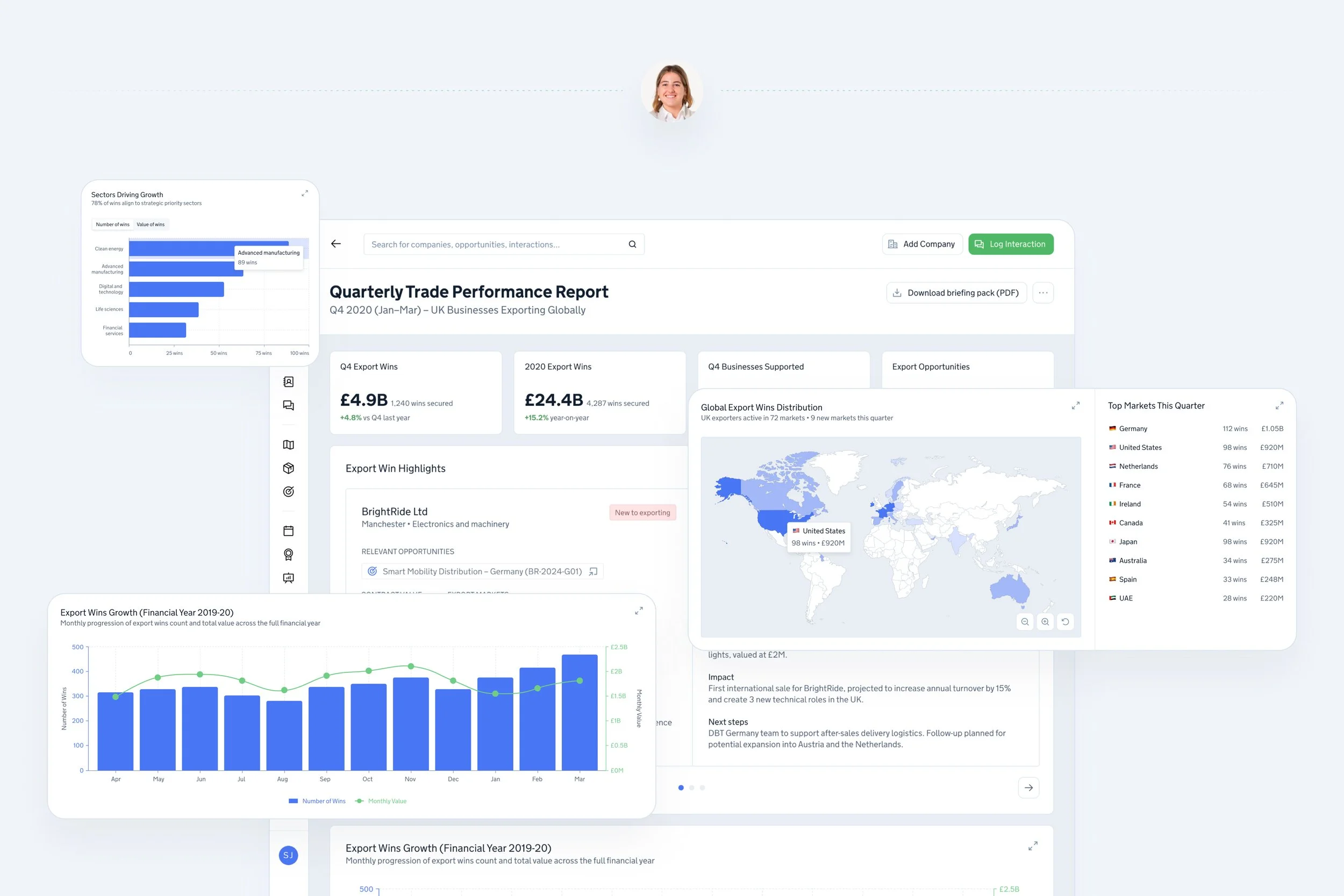
Performance reports draw their data directly from confirmed export wins.
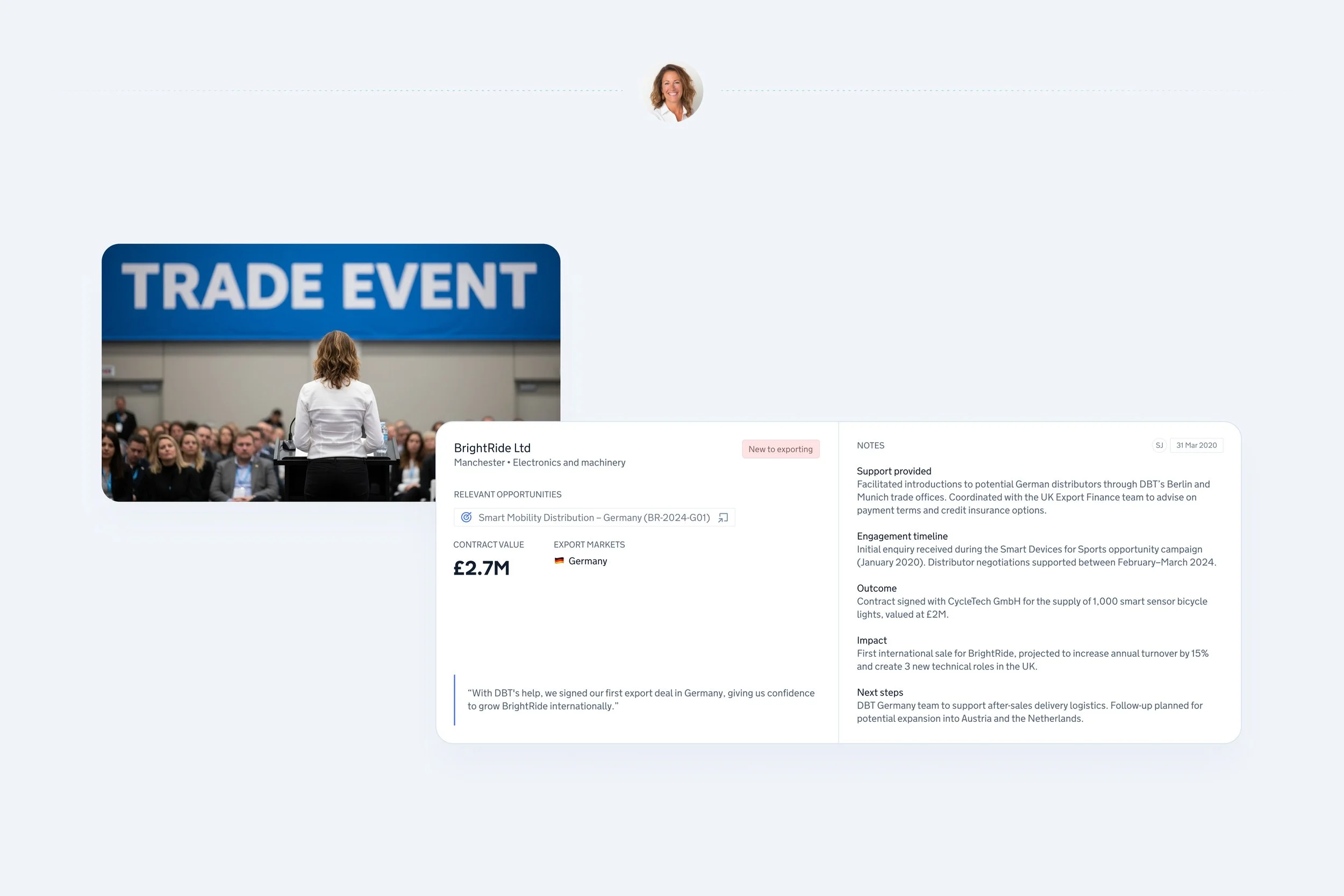
Ministers use stories like BrightRide’s to show trade impact, identify high-growth sectors, and prioritise market engagement.
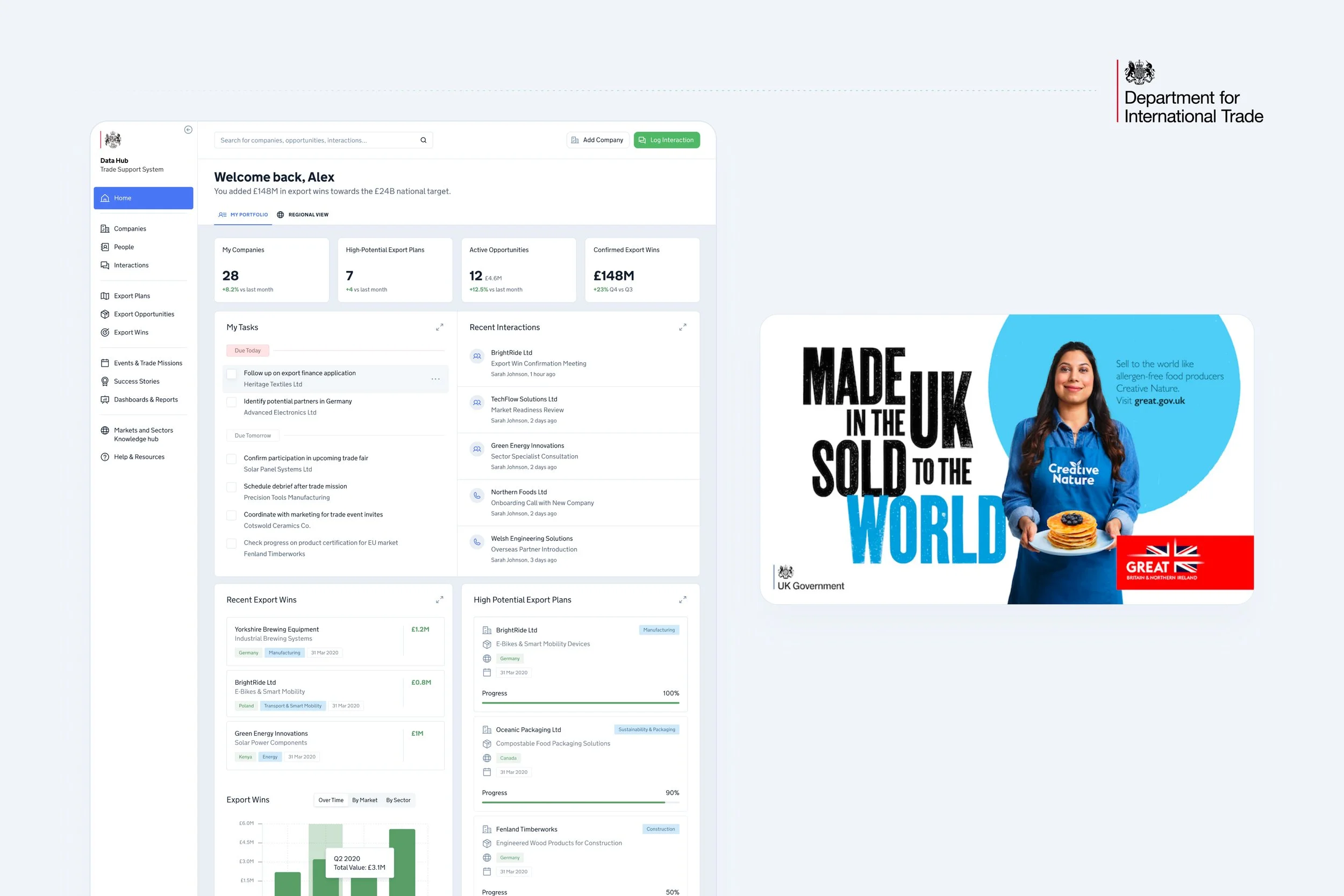
Real founders like Julianne Ponan followed similar journeys proving the platform and services worked in practice.
Outcomes
Delivered a coherent export-support platform spanning public and internal tools.
Improved Data Hub usability, data quality, and adviser efficiency across global trade teams.
Enabled over 3,000 advisers in more than 100 countries to log over 1,000 daily interactions, reaching 4 million customers by 2024.
Replaced costly, inflexible enterprise CRM with a bespoke, licence-free tool praised by users
Unified previously separate services into one continuous journey from learning to export wins and ministerial reports.
Underpinned £24.4 billion in export wins (2019–20), surpassing the national target of £20.9 billion.
Contributed to 5% of UK businesses considering exporting for the first time.
Established design as a strategic partner to policy and technology.
Raised design maturity by embedding data-informed decision-making and shared principles across the department.
Data Hub user, 2023
Frankly, Data Hub is a doddle to use.