Head of User-Centred Design, Hitachi Solutions Europe
Practice Leadership: Scaling a 30-person design and research organisation powering £100M+ digital delivery
From a blank page to a strategic partner shaping over £100 million in Microsoft-powered delivery


Executive Summary
As Head of User-Centred Design at Hitachi Solutions, I built a 30-person design and research team embedded across Dynamics 365, Power Platform, AI and Azure transformation programmes.
Working inside Hitachi’s global Microsoft partnership, we moved design from a reactive support service to a strategic capability that shaped bids, reduced delivery risk, improved adoption, and helped to secure over £100 million in new business. The practice delivered one of the first scalable AI use cases for UK Government and helped Hitachi become Microsoft’s 2025 Global Government Partner of the Year.
Today, design influences pre-sales, discovery, delivery, and how organisations innovate with Microsoft technology.
Context and Challenge
Hitachi Solutions is a global Microsoft partner delivering large-scale enterprise transformation.
When I joined, there was no User-Centred Design (UCD) capability. Design activity was inconsistent, introduced late, and disconnected from technical and commercial decision-making. My remit was to build a new practice from scratch and prove that design could improve delivery quality and client outcomes in an organisation known for technical excellence..
Success depended on three things:
Credibility
Demonstrate design’s impact on delivery quality and adoption.
Capability
Build a multidisciplinary practice with defined roles and progression.
Commercial alignment
Tie design outcomes to business performance and client value.
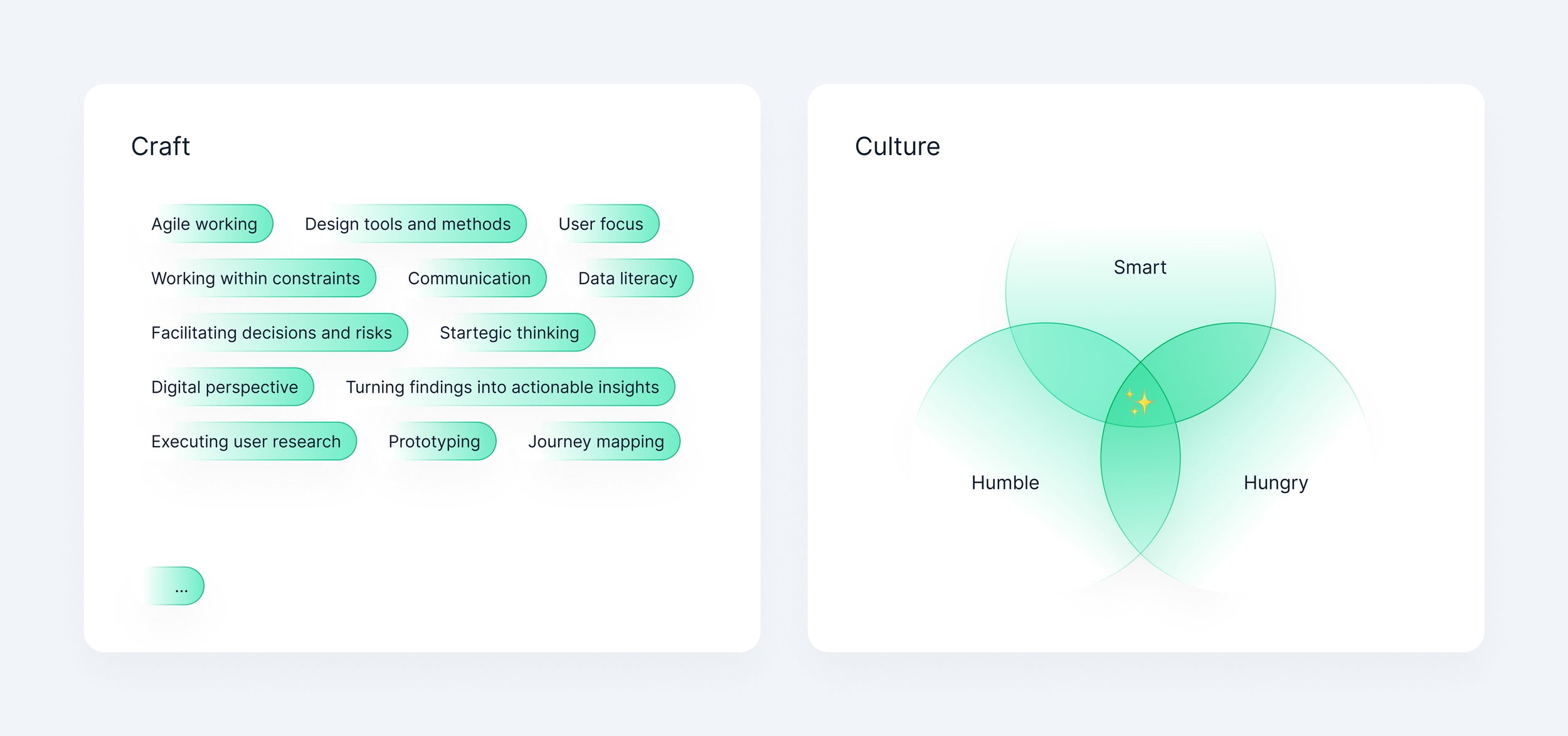
Our capability model blends skills with behaviours. Craft defines what people must be able to do. Behaviour is guided by Patrick Lencioni’s The Ideal Team Player framework: being humble, hungry and smart in how they collaborate.
Building the Practice
With no initial investment or framework, the practice had to grow organically. I began by forming a cross-disciplinary leadership group across service design, UX, research, and content. This group set direction and standards before we scaled delivery capacity.
We introduced clear roles, recruitment criteria, and structured onboarding. This supported sustainable growth across four countries and took the team from zero to thirty people in eighteen months.
To build trust and shared purpose, we adopted principles from Lencioni’s Five Dysfunctions of a Team, building trust and encouraging openness, feedback, and accountability. We created Quarterly Design and Research Days to pause delivery, share lessons, tighten standards, and build cohesion across regions.
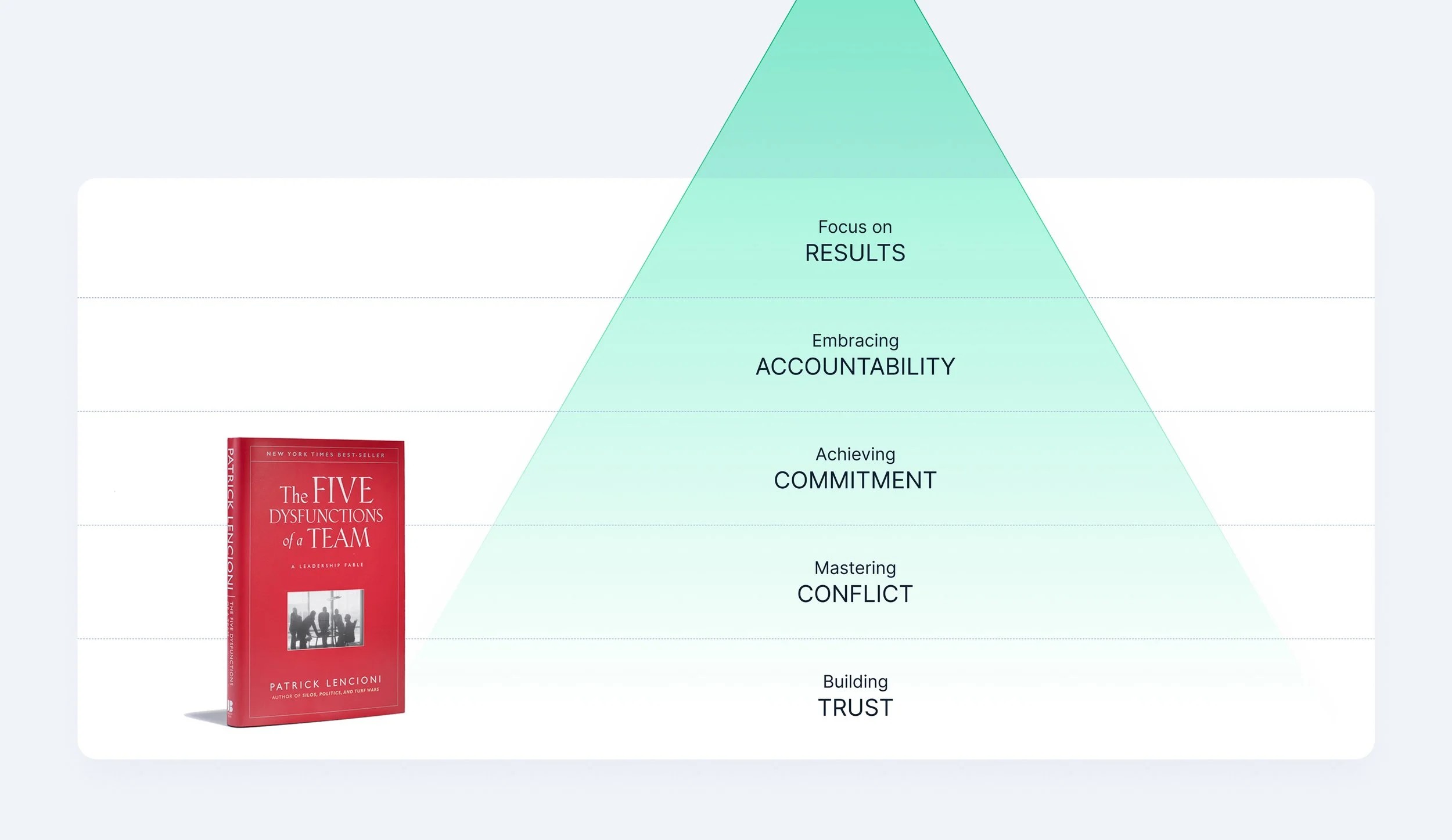
The foundation for our team rituals and leadership culture was inspired by Patrick Lencioni’s The Five Dysfunctions of a Team framework. We used this model to build trust, embrace positive conflict, drive commitment, strengthen accountability, and focus the entire distributed practice on meaningful results.
Practice Foundations
We put core structures in place that allowed the practice to scale while maintaining quality:
Discipline frameworks for UX, Service Design, Content, and Research
The Experience Architect role to connect user needs with business and technical requirements
Mentoring, skills assessments, and structured career pathways
A Community of Practice that connected designers across Europe and North America through shared learning and coaching
From Blank Page to Strategic Partner
I defined a three-horizon strategy that guided the evolution of the practice:
1
Strengthen the core
Build a credible design team delivering consistent quality.
2
Expand strategic reach
Position design as a partner shaping opportunities, not just executing them.
3
Redefine design’s value
Make user-centred design integral to Hitachi’s Microsoft partnership and sectors growth.
This aligned the practice with consulting priorities such as diversification, stronger Microsoft relationships, and improved delivery outcomes.
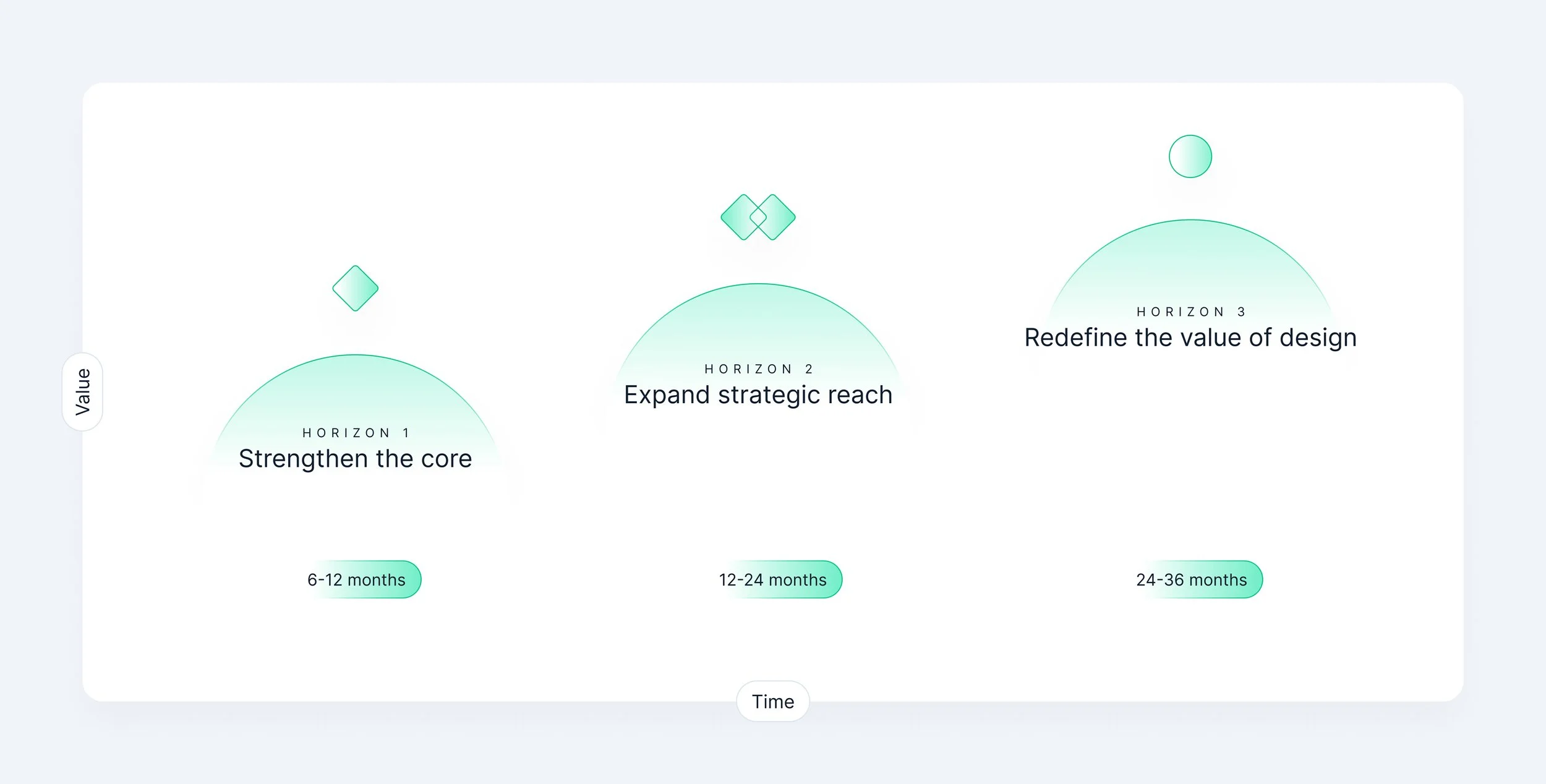
Our three-horizon strategy set out how design would evolve from a delivery capability to a strategic partner. Horizon 1 stabilised the core, Horizon 2 expanded design’s influence into bids and upstream opportunity shaping, and Horizon 3 redefined design as a driver of innovation inside Hitachi’s Microsoft practice.
Growing Capability Beyond the Practice
As the practice grew, so did our leadership responsibilities. I supported not only designers but also cross-practice leaders in Data & AI, Customer Engagement & Power Platform, Finance & Operations and Delivery. I coached new design leads, mentored consulting directors, and created a leadership ladder that aligned expectations across disciplines.
This combination of coaching, diplomacy, and championing helped embed human-centred thinking into programmes led by others, raising design maturity across the organisation.
We launched a Graduate UCD Programme in Porto and created re-training pathways for consultants who wanted to move into design and research roles. The Graduate Programme started from User Research training, and later shifted to more “UCD Consultant of the Future” generalist role. This built internal capability and increased design literacy across the business.
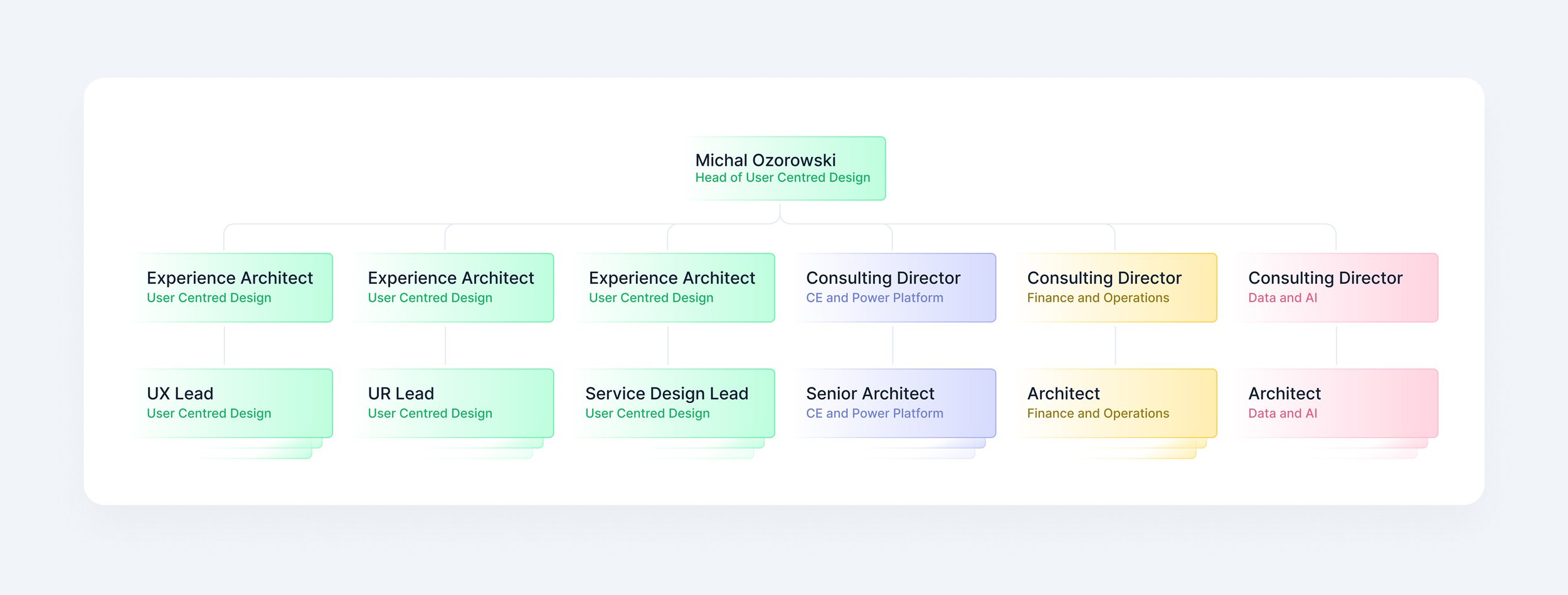
My leadership span: Experience Architects, discipline leads, and design managers, alongside Consulting Directors across CE, Power Platform, F&O, Data and AI. This structure enabled cross-practice alignment while keeping user-centred design at the heart of delivery.
Embedding Design in Delivery
We adapted Hitachi’s Consensus Delivery Methodology to embed design throughout discovery and delivery.
Cross-functional teams co-authored playbooks that connected research, service design, UX, content design, architecture, and development into a single workflow.
Early design involvement clarified scope, reduced rework, improved adoption, and strengthened delivery across major Dynamics 365, Power Platform, and AI programmes.
Selected Programmes and Strategic Projects I Oversaw
Department for Environment, Food & Rural Affairs Smart Environment Regulation Programme
Environment Agency Environment Monitoring and Planning Programme
Foreign, Commonwealth & Development Office 2030 Diplomatic Impact Strategy
Foreign, Commonwealth & Development Office User-Centred implementation model for Microsoft Power Platform Centre of Excellence
Department for Transport AI transformation for HR
UK Export Finance AI transformation for HR
Environment Agency AI Factory, user-led framework for scalable AI use cases
Rolls-Royce Civil Aerospace and Business Aviation Usability improvements to CRM solutions supporting the lifecycle of sales, leasing, and engine maintenance
Chanel Low-Code Transformation Strategy
Proving Business Impact
We tied design activities to measurable outcomes.
In bids, we demonstrated how early user understanding lowered delivery risk and increased ROI. During delivery, we linked design decisions to KPIs such as productivity gains, adoption, and time-to-value.
By the time the practice matured, design appeared in RFPs, commercial strategies, and pre-sales, directly contributing to over £100 million in sales.
Accelerating Innovation
We made innovation practical by turning early ideas into working solutions.
The team introduced design sprints that helped tackle complex enterprise challenges in days instead of months, and led AI initiatives focused on raising productivity through automation.
One example was the AI Risks & Impact Assessment Tool, a lightweight, user-led way for organisations to assess feasibility, risks, and expected impact of AI use cases before committing to delivery.
Alongside other prototypes, from AI-assisted research tools to workflow automation, it informed client strategy, reduced uncertainty, and delivered measurable operational gains.
Impact
Built and led a 30-person design and research team across four countries.
Helped secure over £100 million in new business for Hitachi Solutions.
Delivered one of the first scalable AI use cases for UK Government, achieving measurable gains.
Contributed to Hitachi being named Microsoft Global Government Partner of the Year 2025
Embedded design as a core discipline in Hitachi’s Microsoft partnership
Recognised by Microsoft and client leadership as a model for integrating design with enterprise delivery.
Design at Hitachi Solutions is now a strategic capability.
It shapes bids, informs programmes, strengthens cross-team collaboration, and improves how the organisation works.
We proved that in enterprise consulting, focusing on people and their needs is good business.